Our actions
2026 Brussels CyberVAWG mobilisation
Brussels, February 2026: Building an EU Civil Society Coalition to Tackle Cyberviolence Against Women and Girls
On February 24th and 25th 2026, our Brussels mobilisation to tackle cyberviolence against women and girls brought together a coalition of European civil society organisations working at the intersection of women’s rights, child protection, digital regulation and the fight against online sexual exploitation.
We held a series of targeted meetings with Members of the European Parliament across political groups and exchanges with representatives of the European Commission, combining internal strategy sessions and external advocacy meetings.
A structured European civil society coalition was formalised, bringing together nine organisations working across survivor support, litigation, research, hotline operations, EU advocacy, health, AI analysis and child protection. This multi-layered expertise is its core strength.
The lobbying meetings allowed for positioning cyber-violence as a structural EU policy issue and building a cross-party network of MEP champions to build sustained institutional leverage. Three main threats were identified: the “ChatControl narrative” that heavily shaped the debate around the CSAM Regulation; a rising influence of the far-right in the European Parliament; and the instrumentalisation of freedom of expression to resist stronger regulation of online misogyny, pornography platforms or extremist content.
2025 Strasbourg Symposium
A Collective Call to Address Online Sexual Exploitation in Europe
On February 14th, 2025, Osez le Féminisme and the French Coordination for the European Women’s Lobby organised the International Conference “Online Sexual Exploitation: Challenges and Responses in Europe.” Renowned experts, MEPs, government officials, researchers and civil society representatives gathered to discuss key issues surrounding sexist and sexual cyberviolences and online sexual exploitation.
The transnational nature of cybercrimes requires a coordinated response supported by regional and international cooperation mechanisms.
The increase in lawsuits against the pornography industry, ongoing legal debates on the protection of minors online, the enforcement of Directive 2024/1385 on combating violence against women, and the Digital Services Act, which addresses platform liability, collectively create a favorable context for concrete action to combat all forms of online sexual exploitation.
This conference brought together parliamentarians, government officials, Members of the European Parliament, experts, lawyers, researchers, and civil society organisations. Together, let us ensure the protection of fundamental rights for all online.
Re-Watch the Conference
9:00 am - 9:45 : Opening speeches
9:45 am - 11 am : New technologies, sexual exploitation, and violence against women and men: challenges and responses
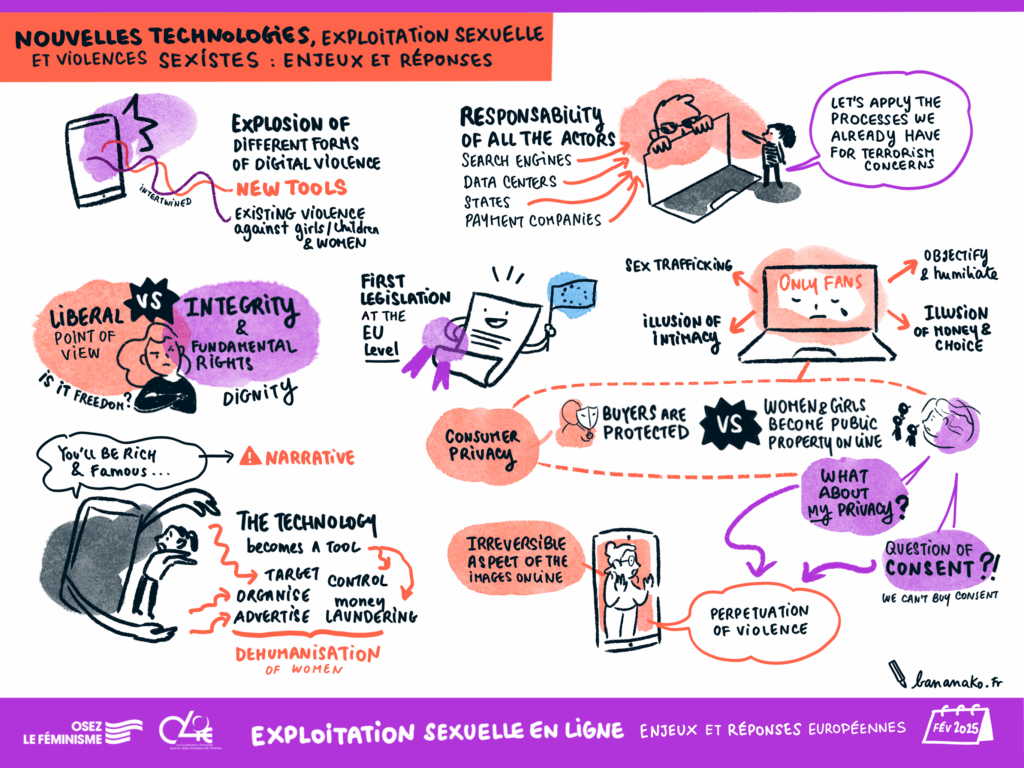
New technologies exacerbate prostitution, surrogacy, and online gender-based violence. Platforms like OnlyFans, where sexual exploitation and human trafficking have been reported (Reuters, 2024), and the growing use of artificial intelligence to humiliate and silence women (+330% in deepfakes between 2019 and 2023, Deeptrace), highlight these issues. While the European Directive on violence against women (2024) is a step toward regulation, it remains insufficient to fully protect their rights. This panel will explore these challenges and propose concrete solutions.
Moderator: Alyssa Ahrabare, president of the French Coordination for the European Women’s Lobby (CLEF)
- Evin Incir, Swedish MEP, rapporteur for Directive 2024/1385 on combating violence against girls and women
- Ruth Breslin, Director of the Institute for Policy Research on Sexual Exploitation
- Mariana Branco, researcher at the Portuguese Platform for Women’s Rights
Questions and answers
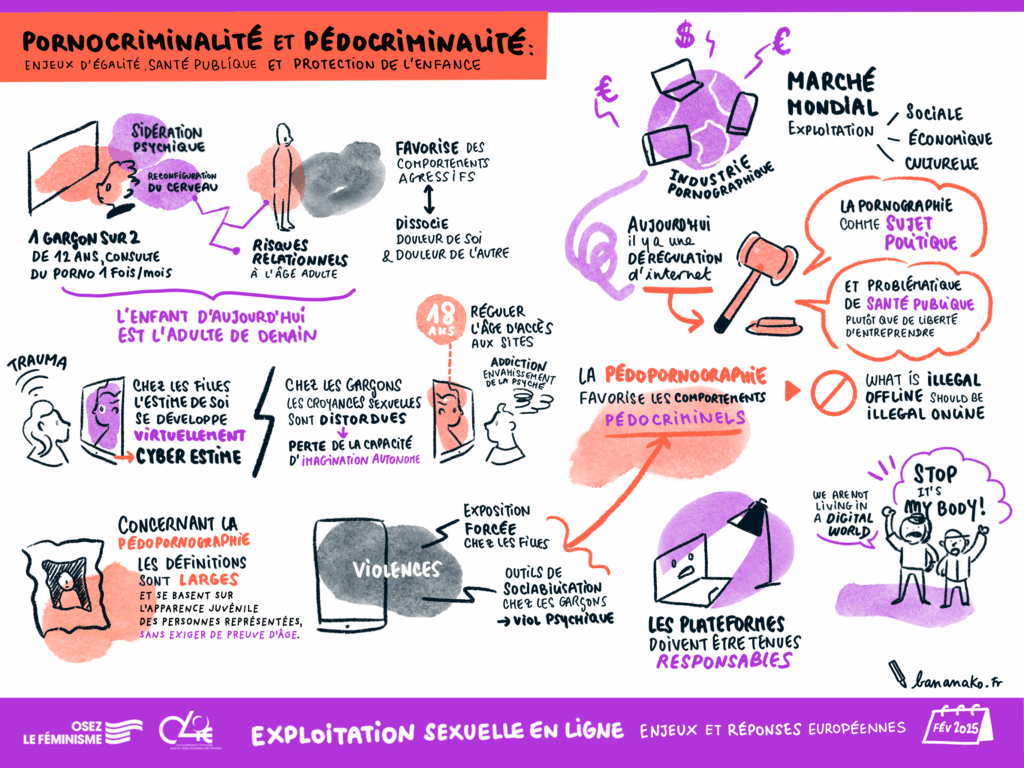
11:30 am - 1 pm : Pornocriminality and pedocriminality : A Concern for Equality, Public Health, and Child Protection
Introduction: Screening of the documentary Be Brave France by Mié Kohiyama
This panel will shed light on alarming data about the impact of the pornography industry on mental health, violence, and the shaping of relations between women and men. A study by the High Council for Gender Equality reveals that 90% of scenes in the most-watched pornographic films contain acts of physical or verbal violence, contributing to the normalisation of aggressive behaviours in intimate relationships. Additionally, the panel will focus on the legal disputes surrounding access control to pornographic websites, highlighting the limitations of current European regulations in protecting children.
Moderator: Aliénor Laurent, President of Osez le Féminisme
- Céline Piques, Rapporteur of the High Council for Equality’s report on pornocriminality, representative of Osez le Féminisme
- Hélène Fritzon, Swedish MEP, Rapporteur of the FEMM Committee opinion on the Directive on child sexual abuse
- María Hernández-Mora, PhD in Psychology, Clinical Psychologist, and Psychotherapist
- Laurence Rossignol, French Senator
Questions and answers
2:45 pm - 3:30 pm : Keynote spechees
- Alyssa Ahrabare, President of the French Coordination for the European Women’s Lobby
- Aurore Bergé, Minister Delegate for Equality between Women and Men and the Fight against Discrimination (video)
- Delphine O, Ambassador, Secretary General of the Generation Equality Forum (Beijing+25)
- Alexandra Louis, Interministerial Delegate for Victim Support
- Maria João Faustino, member of the executive committee of the European Women’s Lobby
3:30 pm - 4:45 pm : Addressing Prostitution : The Impact of Different Policy Models in Europe
Introduction: Testimonial video from Blessing Okoedion, survivor of human trafficking and prostitution, founder of Weavers of Hope
European Parliament Resolution 2022/2139(INI) on prostitution highlights that this practice constitutes a form of violence against women and girls, urging Member States to adopt measures to reduce demand and strengthen the protection of victims. This panel will examine the legislative models adopted in Europe to address prostitution, analyzing their social, economic, and human impacts while integrating the growing digital dimension of this phenomenon and its specific effects on migrant women.
- Maria Noichl, German MEP, rapporteur of the European Parliament’s September 2023 resolution on prostitution
- Françoise Brié, Representative of Amicale du Nid, Vice-President of CLEF, and former GREVIO member
- Adama-Sira Le Blay, President of the European Network of Migrant Women
- Stephanie Caradec, director of Mouvement du Nid
Questions and answers
5:15 pm - 6:30 pm : Current Legal Challenges in France and Europe: Using the Law to End Impunity
Introduction: Video testimony from a survivor of the pornography industry.
In France, ongoing legal cases highlight the key role of the courts in penalising systemic violent practices, including torture, committed by the pornography industry (rape, pimping, human trafficking).
The right to control one’s own body cannot become a right to consent to its alienation.
This panel will offer a crucial perspective on applying fundamental legal principles, such as human dignity and the right to physical and mental integrity, while advocating for collective action to reform national and European legislation on online sexual exploitation.
Moderator: Floriane Volt, Director of Public and Legal Affairs at Fondation des Femmes
- Muriel Fabre Magnan, Professor of Law at Sorbonne University, author of “L’Institution de la liberté”
- Lorraine Questiaux, lawyer specializing in the defense of survivors of pimping and pornocrime
- Mireia Crespo, director and Natasha Malviya, volunteer jurist for Isala field association
Questions and answers
6:30 pm - 7:30 pm : Closing remarks and call to action
Drawing on the day’s testimonies, legal analyses, and discussions, this session will issue an urgent call to strengthen legislative frameworks and intensify collaboration between States, European institutions, and civil society to provide better responses to online sexual exploitation.
- Alyssa Ahrabare, President of the French Coordination for the European Women’s Lobby, and Céline Piques, Rapporteur of the High Council for Equality’s report on pornocriminality, representative of Osez le Féminisme
- Speech by Alexandra Dethyre, Project Manager of the RAJA Foundation
- Presentation of the Strasbourg Call, concrete recommendations co-created by partner organizations, followed by a group photo.
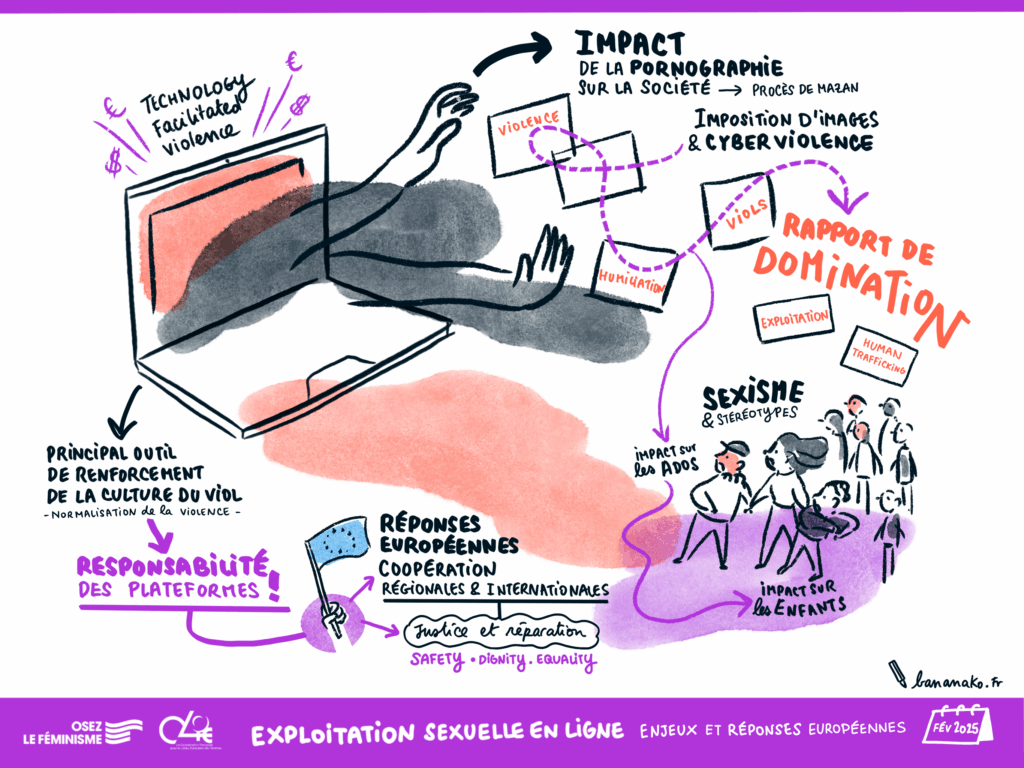
The conference featured live graphic facilitation by Christel Han (bananako.fr). Christel is an illustrator and graphic facilitator. Like an interpreter, she captured and visually transcribed the discussions from the roundtables in the form of drawings. At the end of the discussions, the boards were presented during the Q&A session, providing a visual aid to reflect on the ideas discussed. The finalised boards can be found below.
International events
Digital Futures, Berlin
Osez le Féminisme was invited to host a session on “Tackling Online Sexual Exploitation and other Forms of Online Violence Against Women and Girls: An Emergency in the EU” during the event Digital Futures in Berlin. The aim of this European meeting was to collectively reflect on the future of human rights in the digital sphere, with a particular focus on the challenges posed by disinformation, digital exploitation and online violence against women, girls and discriminated groups.
Towards a Safer Digital Space for Women and Girls
Osez le Féminisme and the European Women’s Lobby organised a webinar to bring the Strasbourg symposium recommendations to the European level and raise awareness on sexist and sexual cyber-violence. More than 80 participants from all over Europe and the world joined, reflecting the international scope of the mobilisation. The discussions highlighted that cyber-violence is a continuation of male violence, threatens women’s democratic participation and demands urgent responses. Attention was also drawn to the limitations of existing legal frameworks, the need to recognise online sexual exploitation as a systemic issue and the importance of European harmonisation.
Legal report – EUCLID Program
Overview: Legal frameworks on cyber violence against women and girls in France and the EU (EUCLID Program)
A strategic partnership was established with the Paris Nanterre University Law Clinic. This partnership relied on close collaboration between a team of law students, a supervising professor, and various organisations to produce an in-depth legal analysis regarding gender-based and sexual cyber-violence and the European regulatory framework.
This work resulted in a comprehensive report that provides an extensive analysis of the four cyber-violence offenses defined by the European Directive 2024/1385 and examines their interplay with other relevant European instruments. It also assesses the current state of French law, identifying gaps, areas of convergence and potential transposition mechanisms.